

Liquid Cooled L/S Band for Satcom Uplinks
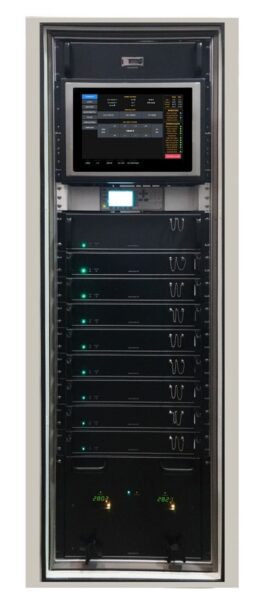
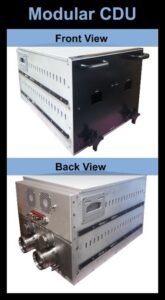
Engineered for the most demanding Satcom uplink applications, the Empower RF Model 2253 SSPA combines cutting-edge solid-state technology with a robust, modular, liquid-cooled architecture. Operating from 1750 to 2120MHz, the 2253 provides a reliable 7kW peak and 3.5kW RMS of digitally modulated output power. The 2253 is the latest member of Empower’s standard liquid-cooled SSPAs built for critical applications requiring extreme solid-state power and highest availability. The 2253 system consists of a 6-foot rack, eight 2U amplifier drawers, a built-in cooling distribution unit (CDU) and external heat exchanger.
The architecture of the 2253 is distributed and modular, the latter allowing fast field replacement of amplifier drawers, the controller and CDU. The distributed RF and power supply design eliminates single points of RF failure, delivering true “always on air” operation and minimizing downtime. The distributed system design provides system redundancies, allowing continuous operation of the amplifier, at maximum potential in the event of partial failures. Similar to N+1 configuration redundancy, the 2253 offers impressive extreme effective MTBF.
The 2U amplifier drawer forms the essential foundation that enables the transmitter’s superior availability. Each 2U chassis is a fully functioning, integrated amplifier—full gain, no external driver or external system power supply at the rack level is needed. The phase and gain of the 2U amplifier is set digitally. The rear panel consists of blind-mate electrical and proven dripless liquid connectors, ensuring seamless and rapid field serviceability. No cabling to deal with and access to the rear is not required.
The System controller for the transmitter incorporates a high-speed embedded computing architecture to ensure precise control, monitoring, and protection of the individual 2U amplifier drawers. The system controller is common across Empower’s liquid-cooled family and is capable of managing not only the 2253 system but a scalable version where one or more additional racks are added in parallel for higher power—the system controller manages the combinations as a single entity.
The amplifier system includes a range of advanced features designed to enhance performance, reliability, and ease of integration. The system offers instrument-grade measurement capabilities, delivering precise readings of peak and RMS power. Granular performance monitoring is achieved through real-time tracking of current, voltage, and temperature at both the pallet and device levels, enabling proactive maintenance and system optimization. The amplifier is integration-ready, featuring a Web API that supports seamless communication and third-party system control. The system employs an internal network to connect to each amplifier drawer. To avoid multiple CAT6 cables and connection faults, the system uses a root switch and Rapid Spanning Tree Protocol to provide internal network redundancy and enhance operational reliability.
The architecture utilizes full backplane implementation, eliminating the need for cable or harness detachment during servicing. This not only simplifies maintenance but also ensures compliance with EMI/RFI standards, reducing potential interference and improving overall system robustness. RF power is efficiently aggregated using in-house-designed high-efficiency combiners, while a patented fiber optic data bus provides noise resistance and exceptionally high data rates.
The benefits of this system architecture (summary in Table 1) include a low total cost of ownership due to its modular design, which reduces sparing needs. Rather than purchase a second identical system for backup, only fractional system sparing is needed. For example, a couple of 2U amplifier drawers and one controller would represent a full system backup. The transmitter does not have to be taken offline to service or replace individual amplifiers. Additional benefits include no specialized technician training required and no dangerous high voltages to contend with. This significantly reduces maintenance and training expenses compared to TWT based and non-modular solid state systems.
| User Benefits | Description | Operational Impact |
|---|---|---|
| Exceptional Reliability | Redundancy and distributed architecture, similar to N+1 with no single points of RF failure. | Millions of operational hours (Effective MTBF) with minimal downtime risks. |
| Mission-Critical Uptime | “Always On Air” operation in the event of component or amplifier drawer failure. | Continuous broadcast with highest possible availability. |
| Low Total Cost of Ownership | Modular design reduces upfront costs and maintenance expenses. | Lower capital expenditure and lifecycle costs compared to non-modular systems. |
| Rapid Repairs | 15-minute amplifier drawer swaps. No specialized training required. | Reduced repair time and labor costs for mission-critical environments. |
| Scalable Power | Add 2U amplifier blocks or entire racks. Combiner will need changing. | Flexible power expansion without system redesigns. |
| Waveform Flexibility | Precise low-latency adjustments and complex modulation support. | Enhanced signal agility for dynamic mission requirements. |
| Future-Ready Architecture | High-speed processing and FPGA design allow DSP inside the amplifier. | Long-term adaptability to new waveforms and mode scenarios plus a roadmap of signal processing functions. |
| Simplified Maintenance | No high-voltage supplies, intuitive diagnostics, common GUI across the family. | Reduced technician workload and error rates during servicing. |
| Fractional Sparing | One or two 2U amplifier blocks + one universal controller as backups. | Lower inventory costs while maintaining redundancy. |
| Broadband Agility | Faster frequency hopping and wider instantaneous bandwidth. | Adaptability to dynamic spectrum requirements in real-time operations. |
| Seamless Integration | Web API compatibility and standardized interfaces. | Faster system integration with reduced customization needs. |
Forward looking, the 2253 SSPA provides exceptional adaptability for evolving mission requirements through its waveform versatility, which supports complex modulations and rapid frequency hopping to meet dynamic operational demands. Scalable power ensures seamless expansion via 2U amplifier drawers or full rack additions, enabling capacity growth without system redesign. Advanced waveform control delivers precise low-latency adjustments of complex digital modulation schemes and provides for dynamic operational mode changes. Additionally, the future-ready architecture incorporates the ability for signal processing enhancements aligned to a structured technology roadmap, ensuring sustained performance and compatibility with emerging requirements. Together, these features position the system as a long-term, high-flexibility solution for advanced communication applications.
The significance of solid-state, high-power transmitters for SATCOM, TT&C, and Space EW applications cannot be overstated. Increasingly complex waveforms, spectrum management requirements, and multi-mission demands on ground-based infrastructure and deployed systems require intelligent amplifiers that combine high-performance RF, thermal management, and embedded computing control. The 2253 and Empower’s patented architecture delivers that.